After a few weeks of uncertainty in March, the fishing industry exploded in April and has continued to see record sales throughout the summer months.  Our article from the end of April outlined what brands and retailers were experiencing during the early weeks of the Covid-19 pandemic.  We now take a look at where they are now after several months of everyone adjusting to Covid-19.

Frequent anglers and first-time anglers quickly realized that fishing was an effective way to get outside and social distance.  Fishing license sales soon started jumping across the country, with several states seeing record license sales with large increases over the same periods for 2019.

Boat ramps across the nation were experiencing record traffic with packed parking lots during the week and not just full on the weekends.  Nice weather and great Spring fishing across the country coincided with other activities being limited and people looked to fish for the first time and to fish more often. Numerous people that were laid off or were now working from home used their newfound time to fish for food and entertainment, pushing license sales up for nearly every state.  Even states that had closed outdoor recreation like Washington state in March and April saw license sales rebound quickly when they reopened those activities.  The Chinook Observer reported that the Washington Department of Fish and Wildlife reported $300,000 of license sales in a single day on April 27.

The Recreational Boating and Fishing Foundation along with Takemefishing.org reported the 3.1 million new participants, the most in five years and 50.1 million total participants the most in 12 years in 2020.  Female participation was also at an all time high.  Other key figures showed youth participation up over a million participants over the last seven years.  Hispanic fishing participation hit an all time high at 4.4 million and fly-fishing saw record levels as well at 7.0 million.  Fishing and camping also saw a lot of cross over participants with an increase of 7.7%.  Camper sales sky-rocketed as states loosened stay at home orders and people chose to buy campers and use them for vacations this summer, with many of those trips including fishing.

Tournaments also returned in May with new policies to insure social distancing and safety for the anglers. Online registration, texting updates, no pre-tournament meetings and distanced weigh ins allowed events to proceed safely without any Covid-19 outbreaks. Participation returned to pre-pandemic levels and even increased to larger than previous fields.

What specific trends did retailers and manufacturers see in the fishing industry into the summer?  As in the early weeks, online sales continued to surge, leading established online retailers and new online retailers to record sales numbers in April and May.   In many cases those sales have continued to surge into later summer. Online orders that normally shipped the same day now saw lead times up to 14 days as order volume grew to record levels and companies were not at full operating capacity as their staffs worked under social distancing guidelines.

Often the ICAST show in July causes a bump in sales around the launch of new products., but 2020 has seen sales above normal levels even in the later parts of summer.  As retail stores re-opened or transitioned to longer hours their demand and traffic surged as well.  Many shoppers felt more comfortable visiting smaller, local retailers rather than large chain stores, resulting in sales surges for independent retailers.  First time anglers visited retailers at all levels and sought out equipment to help them get started fishing.  Demand for hooks, weights and beginner rod and reel combos surged to never seen levels with retailers quickly selling out. Keeping inventory for brands has also been a challenge as they see a deluge of re-orders.  Customers that normally have done $3,000 of business in a year are now ordering $3,000 at a time with 3-4 orders already this year.  One retailer in the Midwest that had been in business since 1973, had the biggest sales month in the history of their store during the month of May.  Nimble retailers have learned to adapt to a different business model incorporating a blend of tactics that were previously successful with a new mix of tactics to comply with changes from the pandemic.  Many retailers that were resistant to delivery and customer pick ups have now embraced it.  Others that resisted wearing masks are now wearing them full time in their stores for their protection, but also to give customers confidence their stores are a safe place to shop.  With the pandemic this year, ICAST went to a virtual show with mixed results for the brands that participated.  Media coverage has become an important part of the ICAST show and this year was much different with the event not being in person. Brands and media members all found new communication platforms to transfer new product information. The biggest challenge facing most brands during the virtual ICAST was that the buyers in many stores were so busy trying to keep up with inventory that they have had little time to focus on new products coming out in the next month. Nearly all their focus has been on immediate replenishment rather than pre-booking new products arriving in the coming months.

Saltwater anglers continue to take advantage of the lower gas prices to take longer trips offshore for less pressured fish or different speciies.  Sales of bait like ballyhoo for those offshore trips continue to be very high and some tackle stores will now even deliver bait right to your boat.  Bottom fishing equipment and safe release equipment sales have surged in the Gulf states as anglers targeted snapper in season.  Surf fishing continues to be strong, even in areas where beaches are closed to other activities.  Sales of rigs, sand spikes and tape measures have never slowed down this summer. As people are taking more regional vacations, these coastal areas have seen a continued surge in anglers this summer.

Demand for basic terminal items like hooks from Gamakatsu or swivels from SPRO spiked in freshwater and saltwater markets.  Most stores quickly saw their pegs emptied for basic terminal items and were unable to re-fill those pegs as manufacturers and distributors were sold out also. Brands with their own manufacturing or domestic manufacturing have been able to react more quickly in many cases, but the demand has even pushed domestic manufacturers way behind on shipping orders.  Jigheads and lead products have been virtually non-existent for many retailers. Lead sinkers, split shots and bullet weights are sold out and companies like Big Bite have seen unprecedented demand for jigheads during this period. Typically, companies see a slow down in August and September, but this year brands like Big Bite have remained much busier than usual for this time of year. Tungsten sinkers have also been in short supply.  Brands have been sold out of key sizes. Denali launched their Kovert Series weights during the period and saw them sell out in less than two weeks.

Fluorocarbon and braided line sales have seen the most growth in recent years as they gained favor with anglers in all markets.  This year saw the largest surge in nylon line sales in the past 10 years as new anglers purchased nylon to take on their initial trips. Nylon lines are often the choice of first time anglers, due to lower price points.  Companies like Sunline that are known for their fluorocarbon also experienced a surge in nylon sales.

While all retailers saw a surge after the initial closures, those retailers that offered products in six key categories found the perfect retail mix for the pandemic. Guns and ammo, bicycles, fishing, fitness and camping categories all surged during the pandemic to the benefit of retailers like Scheels and Academy. Academy reported net income of $157.7 million on revenue of $2.74 billion for the six months ending August 1st this year, following net income of $73.8 million on revenue of $2.31 billion in the same period last year.

Retailers that offered boats and marine repair also saw record demand in that category. Many boat retailers are now sold out of boats and motors and have their service centers booked out for more than six weeks in many cases for repairs.  There is a Boat Buying Frenzy-June 03, 2020 from Boattest.com. “From all over the country, we are now getting reports that a boat buying frenzy is playing out at many dealerships. One financial institution is saying its boat loan business is up 31%. BoatTEST has seen a huge spike in boat research on its website, something echoed by virtually all major online classified services.” Boattest.com also reported in a reprint from Soundings Trade Only —

Marine dealer sentiment shot to their highest levels since 2018, with the outlook on current conditions measuring 76, versus 19 in April, according to a new survey.

“The ‘family’ has recognized due to the pandemic, vacation is out for this year,” wrote one dealer respondent. “No amusement parks, hotels, cruises, destinations closed, etcetera. So, let’s look at boating!”

The pandemic has created “a surge in interest in socially-distanced outdoor activities, but the true impact on retail demand is hard to parse — even for those in the industry,” read the Pulse Report. “I’ve never seen a buying frenzy like this,” wrote one retailer. “Is this a short-term bump or is it a long-term change in consumer habits?” Used Boat Sales Picking Up, Too. “Preowned is moving fast, and not just extremely clean product.” However, another remarked: “Deals getting tougher to do, as trade values are trending way above book value.” Used lean inventory and higher used boat prices support higher levels of new boat sales — a positive for OEMs. “Our checks support anecdotal evidence that consumers are shifting their leisure time and dollars to socially-distanced outdoor activities,” said the report.

The kayak segment of the market has seen the same sales trend as the larger boats. Sales for kayaks and kayak equipment have been on fire across the country.  Kayaks give anglers a lower price point to enter the boating market and the chance to access many smaller fisheries located close to their home, even in urban areas.

The biggest challenge most retailers are facing in late summer is getting enough product to fill their shelves back up.  Dealers placing weekly orders of $20,000 with distributors may only be able to get $4000 worth of product even when using multiple sources, because the distributors are struggling to get inventory from the manufacturers.  While basic terminal items continue to be difficult to source, the availability challenges have also extended into higher retail items like rods and reels which are now sold out for months in many cases. Denali Rods was expecting a major down-turn in the first weeks of the pandemic and now are seeing record sales and challenges to keep top sellers in stock. Electronics sales have also swelled as anglers fished more and sought out new electronics to upgrade their current boats or outfit a new rig.

What has happened with clothing and gear during the pandemic? Leading clothing brands like AFTCO initially saw dramatic drops in sales and orders during the early weeks of the pandemic.  That quickly turned to exploding sales that aligned with planned 2020 goals. Unexpected at the start of the year, facemask sales continue to upsurge as more and more parts of the country recommend the use of face coverings.  With anglers fishing more they also are looking for better clothing to be comfortable on the water, pushing clothing sales higher even if they are not trying it on first in retail stores.

Many brands and retailers were offering sun shields for their customers in previous years, but the pandemic exploded sales on those products as they became used for face masks in addition to sun protection. Fishing retailers quickly became a reliable source for consumers looking for facemasks and many acted quickly to secure additional inventory from any brand that had them. Their was certainly an initial surge when masks were first recommended, but the demand has remained strong as activities and schools have opened back up this Fall.   Clothing brands like AFTCO quickly pivoted production to increase output and launched charity initiatives around the mask sales, to give away one for each for each one sold. In AFTCO’s case it has resulted in the donation of over 200,000 masks to charities to this point.

The industry remains very positive and expects the balance of the year to finish on a strong note.  Brands in many cases already have orders for the coming 30-60 days and expect to see above average demand in the Fall as more anglers continue to fish and rescheduled tournaments from the Spring now take place in the Fall.  Brands continue to ramp up production to build inventory and deliver new product launches. Retailers will continue to search any available sources to fill their pegs.  Retailers will also need to adjust this fall to virtual shows for many of the popular distributor shows.  Several of those have already been changed to a virtual format for Fall, so retailers will need to learn the most effective way to order and learn about new products digitally instead of attending shows where they normally see all the new products and place their orders for the coming season. Many retailers are working hard to manage their hunting and shooting business, while also working to secure additional fishing inventories to support the rest of the season and insure they have full shelves in the Spring.

Anglers are traveling safely to reach fishing destinations around the state they live in but are also taking out of state trips this Fall. With many activities still being limited or not taking place, fishing will continue to be a safe way to socially distance thru the Fall fishing season.


Is your tournament fishing a business?

It is October and you and your partner just won the year end championship and the $20,000 cash prize that goes with it.  You drive home from the lake thinking about a new Lowrance Ghost Trolling Motor or Garmin Livescope along with something to keep your wife happy for letting you be gone in the first place.  Maybe even a down payment on that new Skeeter FXR you have been looking at.  You mentally spend the $10,000, your half of the winnings, before you even pull in the driveway back home.  The next day when telling your buddy at work, he asks “how much you owe in taxes.”  Taxes, you never even thought about that, how much could it be on $10,000? Your tax bill for that will be at least $2,500 and could go as high as $3,960 for just the federal portion, not to mention state taxes if they apply where you live.  Many anglers in this situation now decide they will make fishing a business, collecting receipts and tracking expenses for the year to offset some part of the $2,500-$3,960 owed.  Sounds like a great idea, until your tax advisor or the IRS tells you, your fishing is a hobby not a business and you can’t claim your fishing expenses.  Who wouldn’t want to write all of their entry fees, travel, gas and especially your Tackle Warehouse bill off as “business expense”?  I guess the seven new $450 Denali/Shimano combos and five $59 Bull Shads aren’t a “business expense”.  If the IRS does determine your operation is a hobby you will be forced to pay tax on the income and cannot deduct any of the expenses.  You also are technically required to claim any cash or prizes you win even if they are less than $600, and typically will receive a 1099 on those winnings.

Many anglers believe it sounds like a great idea to take their expenses from fishing tournaments and buying tackle and claim those expenses against their tournament winnings, but can you really do that?  Your first step should be to ask yourself is my fishing truly a hobby or a business?  That is an easy question to answer if you are planning a professional fishing career, but what if you just want to fish local or regional events.  Ask yourself more specifically are you trying to make a profit from your fishing even if you keep your full-time job?  If the answer is yes, then you are going to need to treat it like a business from the beginning, so that when your tax advisor or the IRS looks at it they will clearly see it is a business.  Most anglers start off with the intention of making a profit, but realistically very few can do it fishing on a local or regional basis. It can be a challenge even at the tour level for many anglers. If you plan to progress to a professional fishing career you will have to start at lower levels like the BFL, Tackle Warehouse Pro Circuit events or the Bassmaster Opens and work way your way up.  Starting your business now to progress thru the steps is a good investment in your planned career goal and sets you up to use losses against income for tax benefits as you begin to fish for higher prizes.  This is a good time to note that a business that loses money for three years in a row or for three out of five years consecutively is going to potentially raise red flags for a closer examination and may be considered a hobby after further review.  The IRS hobby rules are a facts and circumstances test, with good records and receipts you may be able to get beyond this thresh hold and still not have your business considered a hobby.

If you plan on fishing for a living or having fishing be some sort of sideline business, you need to make sure you treat it like one and keep perfect records. The longer you stay in the industry and the more money that passes through your business, the more likely you will be audited. Fishing is not a standard or normal job that has standard income and expenses. Numerous red flags are raised when the IRS reviews your tax return because although lots of money may come in, we have very large expenses as well. All these expenses may be legitimate, but you just need to make sure they are documented properly.

If you want to claim fishing expenses as a business, you must treat your fishing like a business.  Keep expenses separate, use a different bank account with a separate credit card.  Do not mix your fishing expenses from tournaments with other fishing or your regular personal accounts.  Keep all your tournament expenses in specific expense reports connected to the travel of your tournament schedule.  Consider setting up a legal structure to hold your tournament fishing business operations and obtain a federal and state tax identification number.  Other things to make you look professional include having your resume or sponsor proposal up to date, get business cards for you company, so it looks and operates like a business. Looking for more information about obtaining sponsors check out this great guide here.    A good “best practice” for proving business vs. hobby is to have a business plan that is continually updated so you can prove that you are continually adjusting your business to

  1. a) make it profitable if it is showing losses or
  2. b) to continue to make it more profitable.

It is important in the hobby vs. business discussion to have an updated, detailed business plan that shows the adjustments you are making to your business to make it better goes a long way in this argument.

Build out your yearly tournament schedule and construct a projected profit and loss statement from your yearly schedule.  This will also help you clearly understand your goals for the season.  When you travel to each tournament on your calendar, create an expense report for each event.  Keep all receipts and corresponding credit card statements from each event.  Document all of them in the expense report or related Excel file for quick reference.  If you enter all your expenses into an Excel file you can categorize different expenses to quickly total and sort.  Carefully track and record your mileage from each event and document that all with corresponding receipts.  It is not always possible to claim 100% of purchases as expenses also as some portion of them may be deemed personal.

Many people think they will just gather the information if they need it or if they become are audited, but it can be very difficult to remember and create all the necessary documentation months after it occurred.  IRS regulations require you to keep contemporaneous records as you incur the expenses and not create it all after the fact. If you want it to be a business, treat it like a business from the start.  Many anglers think it won’t happen to them, but take the advice of Bassmaster Elite Series pro, Chad Pipkens, who has been thru an audit that lasted over two years.

“I was audited over a two-year period for my fishing business. They wanted to verify that all the expenses I had were true. Anything you don’t have a record of technically did not happen which would make you liable to pay taxes on those monies you said you had spent if you cannot verify a receipt,” stated Pipkens. “The more organized you can be the easier it is to produce these documents. At the minimum you should be creating at least an Excel spreadsheet which has dates and each of your receipt’s amounts. You should also have a column which has an abbreviation for which tax category of this receipt would file under. For example, one could be supplies, meals/entertainment, repair maintenance, etc. this can help you easily sort each expense category at the end of the year. It is also important to keep these receipts physically if you are not logging them electronically. I kept all of mine in order in Ziploc bags for each season. The toughest thing about being audited was that I had to reproduce each of these receipts and get them on an electronic form for the government to view. It worked but I had to spend some 25 extra hours to put the document together. “Pipkens continued.

“After learning from that I now use an app called Receipt Bank. I take a picture of each receipt and it stores it electronically as well as pulls some of the data like amount and date and tax category of the receipt. At the end of the season, I can export these so that I can easily give it to my accountant with the totals for each category of expenses. I also now have electronic receipts saved in case I ever need to duplicate them for the IRS again. It will definitely save you some headaches!”  Pipkens concluded.  QuickBooks On-line is a good accounting program that integrates with ReceiptBank and other 3rd party apps that may be a good option for many tournament anglers as their business grows and they need more accurate/robust accounting records.

Another thing to keep is mileage. It’s important to do this for each trip. This way you can log the location and what its purpose was as well as the exact mileage for each trip. When audited and proving mileage you need to have some sort of log and how it pertains to where you were going or what you were doing for work.  It is also a best practice to keep your oil change/maintenance records on your vehicles during this time as well to assist on corroborating the mileage that was driven during the given year.  Each time your vehicle is in the service center, they log the odometer reading which will help you if you are audited to support the miles driven. This can be done in a simple Excel spreadsheet as well. Doing much of this on your own can save you time and money when accounting is done each year. Also keeping good records can help lower your tax bracket and what you will pay in taxes at the end of each season.

Another good reason to consult a tax advisor is to make sure you comply with state nexus rules.   Depending on where you win your money you may have state filing/payment of tax obligations in a different state from where you live considering the recent Wayfair Supreme court decision.

Just because you want your fishing to be a business, does not mean the IRS will agree with you.  Make sure you follow these suggestions and consult with your local tax advisor for the best advice for your situation.

Lara Ewen from Marketing Dive wrote a recent article about what is selling in the Covid-19 pandemic now that everyone has stocked up on essentials.  The article cites alcohol, firearms, sporting goods, home office, and pet supplies as all being categories that were up in April.  “What we’ve seen starting March 20th is a move from a ‘stock up’ position to whatever the next trend is,” said Andy Mantis, chief business officer at 1010reveal, which is part of 1010data, a provider of data and analytical intelligence. “But outside of what people are stocking up on, like staples, almost every category is down by as much as 70% or 80%.”

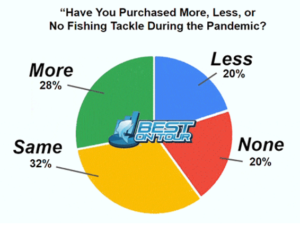
So what specific trends did retailers and manufacturers see in the fishing industry during April as nearly all parts of the country have been under some form of shelter in place. Retailers that sold essential categories like guns, ammo or food have been able to remain open even in the areas with the strictest guidelines.  Sales in those categories along with fishing tackle have been up in many cases which has helped offset store wide decreases in all other departments.   Navigating thru conditions and guidelines never seen before has been challenging for all businesses, some have evolved daily to find ways to support, maintain or even grow their businesses during this period.  Many have now been operating in a similar format for several weeks and have found their operational stride.  This poll from Best on Tour in March surveyed anglers’ thoughts about their purchase choices during the pandemic.

As you can see 60% of anglers in that poll thought they would purchase the same amount of tackle or more tackle during the pandemic.  So, after several weeks what trends have emerged as retailers adjusted their operations and anglers have adjusted their fishing and purchasing habits.

Retailers with an online presence have really benefitted during this time as they could shift all their energy to support ecom sales.  For nearly all, online sales have continued to be strong and have been a lifeline for many retailers and manufacturers that had to close all other parts of their operations.  Some retailers and manufacturers have seen 50%-100%+ increases in their ecommerce business during the end of March and April.  Creative retailers have also begun to offer curbside pick up to allow customers to get their favorite items without having to enter the store.  Curbside pick-up has been particularly popular with rod sales as customers could research online and then provide the retailer with a specific model number which is much easier to pull than a long list of lures or terminal items.  Denali Rods has seen some of their retailers with curbside service continue to see good rod sales.   Some top online retailers are having to limit promotions in order to not create too many sales on a given day as they are currently operating with smaller staffs.  Many of these same leading online retailers are even running up to 10 days behind on shipping online orders.

Going back to the basics.  Many retailers have seen a wave of sales in entry level fishing equipment including starter rod and reel combos.  Many families that are not able to enjoy other outdoor activities during social distancing are trying fishing for the first time with their families.  It has also seen a return to fishing for people that may not have done it in a long time.  The timing of the new social distancing along with the arrival of nice weather and peak fishing season across the country has been a great combination to get people outside fishing.  These new anglers are snapping up entry level combos and starter kits, so they can hit the water quickly with all they need.  This trend has also surged sales on terminal items like hooks, bobbers and fishing line.  Sales for lead products like sinkers and weights have also seen increases.  To complete their needs anglers are loading up on live bait.  Many bait sellers and wholesalers are reporting bait sales at levels they had not seen since the 1990s.  Worms, crickets and minnows have all been in short supply and selling as fast as they are being stocked across the country.  Some retailers would post the arrival of live bait on their social media sites and sell out minutes later.  Even diehard tournament anglers have switched their purchasing habits during the past weeks.  Instead of practicing for a tournament many have turned to crappie fishing for increased action and a chance to have a dinner of fresh fish.  That has seen them buying more jigheads and panfish plastics over their traditional bass purchases.  Companies like Big Bite Baits have seen a tremendous surge in the sales of crappie baits and crappie jigheads.  Keeping those panfish categories in stock the past few weeks has been particularly challenging with demand swelling.

Some tournaments have started to resume bringing a focus back to bass fishing tackle.  Other tournament trails have switched to digital, catch and release or online tournaments to allow people to continue to compete which in turn continues to drive bass tackle sales despite the restrictions on large gatherings.  Soft plastics have continued to be a very popular bass category during this period.  Fluorocarbon sales for companies like Sunline have continued to grow during the period with many customers now buying their line from retailers via their ecommerce websites.

Offshore anglers are also taking advantage of the much lower gas prices to take long trips offshore where they are able.  Sales of bait like ballyhoo for those offshore trips and filling reels with line have started to rise in coastal areas that are opening back up.  The other saltwater category that is seeing an increase is surf fishing.  Sales of rigs, sand spikes and tape measures have increased by 50% in many accounts.  Customers are coming in and saying, “what do I need to fish off the beach?”  Many places have restrictions on their beaches, but are allowing fishing.

While sales for bait, tackle, rod/reels and lures have remained a bright spot for retailers, clothing sales have been significantly impacted during the pandemic.  Online sales of top clothing brands like AFTCO has been one of the lone bright spots for retailers in the clothing category.  Once government agencies started to recommend face shields sales of those products went thru the roof.  Demand for facemasks is even brining non-fishing customers into many stores for the first time just to shop for facemasks.  Smart retailers have made impromptu walls and displays with just facemasks to cater specifically to this new surge in demand.  Brands have seen facemask demand flood to never expected levels in the past three weeks.  Brands with good sourcing and reliable manufacturing have been able to pivot and secure large facemask inventory. Companies like AFTCO have even developed new programs to supply their customers with facemasks while donating free ones to community organizations.

Many retailers have been extremely cautious with inventory and reorders. With some areas now starting to open more businesses and allowing more activities, many retailers have started to place orders to replenish empty pegs from the past few weeks.  SPRO was closed for two weeks to comply with local guidelines and when they returned they had a large numbers of orders waiting to ship, pushing their shipping lead time out to 7-10 days as they operated under new CDC guidelines and reduced staffing policies.  Gamakatsu USA was closed for over a month and has now returned to limited operations and experienced a similar backlog of orders to catch up on. Distributors have remained extremely busy during this period as they fill a wide range of rush orders for retailers across the country.  Some brands have had supply changes impacted and are experiencing product shortages, but others with their own manufacturing or reliable supply changes are picking up extra demand.  Some retailers are also ordering optimistically to support the increased demand they are expecting in the next couple weeks as we enter prime fishing and selling season in the country ahead of Father’s Day.  The arrival of stimulus checks has provided a boost on some higher end purchases as anglers coming in and stimulate the economy with their recently received funds.