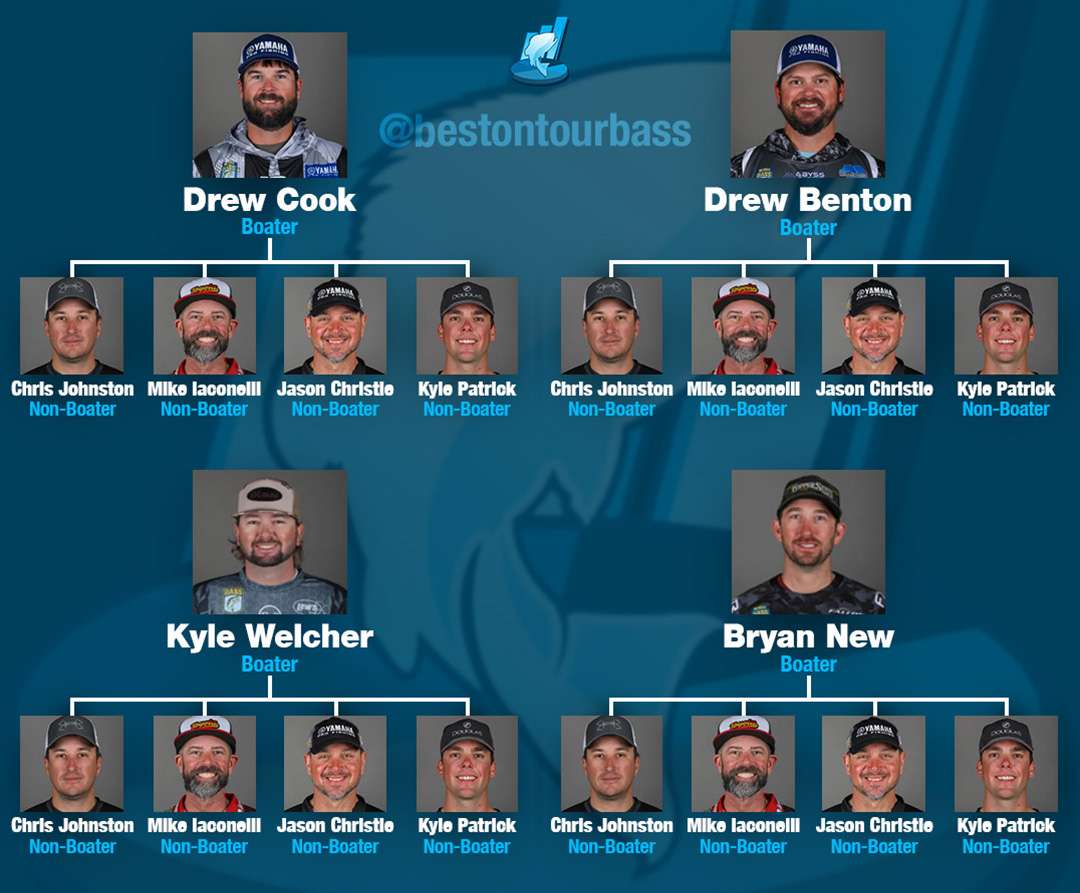
Who is on each team is yet to be determined! Fans will get to vote to choose the team pairings.
Here is every possible team pairing that we might see, browse all the options to help you decide who you want to vote for: Read more
https://bestontour.net/wp-content/uploads/2026/03/bassmaster-tuesday-night-live-teams.jpg8931080Shawn Weldonhttps://bestontour.net/wp-content/uploads/2019/02/Best-On-Tour-Logo-1920-minified-300x127.pngShawn Weldon2026-03-25 07:52:582026-03-25 07:54:25Bassmaster Tuesday Night Live Teams: All the Options
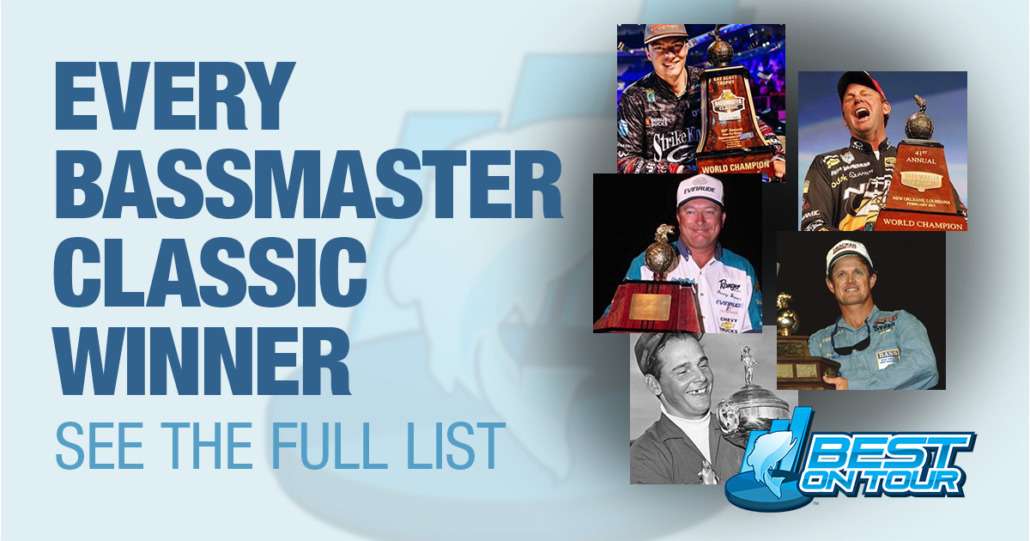
Looking for a complete list of all of the Bassmaster Classic winners? You’re in the right place. Only 44 people have ever won a Bassmaster Classic. Those people are:
Bobby Murray, Don Butler, Rayo Breckenridge, Tommy Martin, Jack Hains, Rick Clunn, Hank Parker, Bo Dowden, Stanley Mitchell, Paul Elias, Larry Nixon, Jack Chancellor, Charlie Reed, George Cochran, Guido Hibdon, Ken Cook, Robert Hamilton Jr., David Fritts, Bryan Kerchal, Mark Davis, Dion Hibdon, Denny Brauer, Davy Hite, Woo Daves, Kevin VanDam, Jay Yelas, Michael Iaconelli, Takahiro Omori, Luke Clausen, Boyd Duckett, Alton Jones, Skeet Reese, Chris Lane, Cliff Pace, Randy Howell, Casey Ashley, Edwin Evers, Jordan Lee, Ott Defoe, Hank Cherry, Jason Christie, Jeff Gustafson, Justin Hamner, Easton Fothergill.
https://bestontour.net/wp-content/uploads/2026/03/every-bassmaster-classic-winner-1200x630-1.jpg6301200Shawn Weldonhttps://bestontour.net/wp-content/uploads/2019/02/Best-On-Tour-Logo-1920-minified-300x127.pngShawn Weldon2026-03-09 15:01:112026-03-09 15:17:55Bassmaster Classic Winners: The Complete List
Table Rock Lake is one of those fisheries that can quickly expose an angler’s weakness, and equally magnify their strengths. Clear water, roaming spotted bass, waves of spawning largemouth, and the ever-present factor of fishing and boating pressure make it a thinking angler’s lake. Combine these factors with a shortened weeknight jackpot style format, and the setup couldn’t be more perfect for the inaugural Bassmaster Tuesday Night LIVE tournament. With this lineup, the intrigue isn’t whether these Elite Series pros can catch them,it’s whose style aligns best with what Table Rock gives them, and ultimately what teams the fans decide to select to tackle the task at hand.
Will angler chemistry play a bigger role, or will fishing styles be the talk of the day? Let’s look at the anglers in the field:
https://bestontour.net/wp-content/uploads/2026/02/bassmaster-tuesday-night-live-angler-breakdown-1200x630-1.jpg6301200Shawn Weldonhttps://bestontour.net/wp-content/uploads/2019/02/Best-On-Tour-Logo-1920-minified-300x127.pngShawn Weldon2026-02-25 10:16:042026-03-23 09:33:50Bassmaster Tuesday Night LIVE Anglers Breakdown
Some links on Best on Tour are affiliate links, meaning we may earn a commission.
We get asked all the time how to rig dice baits. Dice-style baits, AKA fuzzy baits, have exploded in popularity. What started as a secret Japanese deal has turned into a full-on trend. If you’re seeing them on shelves and wondering how to rig them without overthinking it, you’re in the right place.
Below are three simple, effective ways to rig dice baits 👇
Bassmaster Tuesday Night LIVE is the first-ever Bassmaster Tuesday night tournament, taking place April 21, 2026 on Table Rock Lake. Eight Progressive Bassmaster Elite Series pros will compete in a three-hour, team-format shootout from 4:30 to 7:30 p.m. CT, launching from Mill Creek Boat Ramp in Kimberling City, Missouri. The event features fan-voted pairings, a traditional boat-ramp weigh-in, limited commercial interruptions, and a $5000 cash prize, streamed live across Bassmaster platforms.
The format is simple, and that’s the point. Four boats, eight Elite Series pros, and one fast-paced three-hour evening session. Teams will consist of one boater paired with one non-boater, with fans voting online to determine the matchups.
Blast-off begins at 4:30 p.m. CT, and anglers return at 7:30 p.m. for a no-frills weigh-in at the ramp, just like weekly jackpot tournaments held across the country.
The entire competition will be streamed live with limited commercial interruption, allowing fans to follow the action in real time. Spectators can also attend the weigh-in in person, creating a local-tournament atmosphere powered by professional talent.
Why It Exists
Tuesday Night LIVE was designed to reconnect professional bass fishing with its grassroots foundation. Instead of a multi-day production with massive staging and arena weigh-ins, this event mirrors the energy and simplicity of a local weeknight derby, complete with quick decisions, and a short shot clock.
With hosts Mark Zona and Dave Mercer bringing personality and play-by-play from the ramp, the goal is authenticity. No big stage. No overproduction. Just elite anglers competing on one of the country’s most iconic fisheries in April.
How It Differs from the Bassmaster Classic
The Bassmaster Classic is bass fishing’s grandest stage. It is a multi-day championship event with arena weigh-ins, massive crowds, and career defining stakes.
Tuesday Night LIVE is intentionally different. It’s one evening. Three hours. A ramp weigh-in. Minimal production. Bragging rights and a whole lot of smack talk and fun friendly competitive vibes. While the Classic crowns a world champion, Tuesday Night LIVE captures the spirit of the Tuesday night jackpot that everyday anglers know and love.
Admittedly, Tuesday Night Live does pay more than your average tuesday nighter, the payout is $5000 for the winning team, but that is not much compared to the $300,000 that the Classic pays!
Who Should Care
Hardcore bass fans will appreciate seeing Elite pros operate in a compressed, high-pressure format where every cast matters. Local tournament anglers will relate to the short clock and team dynamics. And anyone who loves fishing Table Rock Lake in April knows how dynamic that bite can be.
If you’ve ever rushed to make it to a 4:30 blast-off after work, this event was built for you, just elevated with some of the biggest names in professional bass fishing!
Get more bass fishing industry insights in your inbox every week. The Best On Tour newsletter is delivered on Thursdays at 10am. Sign up HERE!
https://bestontour.net/wp-content/uploads/2026/02/what-is-tnl-blog-thumb-1200x630-1.jpg6301200Shawn Weldonhttps://bestontour.net/wp-content/uploads/2019/02/Best-On-Tour-Logo-1920-minified-300x127.pngShawn Weldon2026-02-18 11:55:022026-02-25 10:32:05What Is Bassmaster Tuesday Night Live?
The first ever Bassmaster Tuesday Night LIVE is Headed to Table Rock!
Elite Series competition is coming to a setting every tournament angler understands — the weeknight jackpot.
On Tuesday, April 21, 2026, eight Elite Series pros will trade the big-stage atmosphere for a straightforward, team-format, 3-hour shootout during Bassmaster Tuesday Night LIVE on Table Rock. Built around the spirit of local weeknight tournaments, the event emphasizes relatability, efficiency, and on-the-water execution rather than spectacle.
Four boats, eight anglers, two veteran hosts, and support from AFTCO, Beatdown Outdoors, Gamakatsu, SPRO, and Sunline all come together to make one of the most exciting and anticipated events in pro bass fishing in 2026!
Schedule: 4:00 PM CT — Angler arrival and pre-tournament coverage with Dave Mercer and Mark Zona. 4:30 PM — Blast-off. 4:30–7:30 PM — Three-hour team competition. 7:30 PM — Traditional weigh-in at the ramp.
The format will feel familiar: no big stage, minimal production, and a quick turnaround — the same structure that has made Tuesday night events a staple in bass fishing communities across the country.
Fan-Selected Teams
The boaters are set, but the fans will determine the pairings by voting on each pro’s partner — adding a strategic wrinkle before the first cast is made.
Boaters
Drew Cook — The 2019 Rookie of the Year has built a reputation on consistency and efficiency, highlighted by an Elite Series victory and a Century Belt performance.
Drew Benton — A Rookie of the Year and multiple-time Elite winner, Benton is a versatile threat nationwide and historically strong during the spring window.
Bryan New — After winning his Elite debut and earning Bassmaster Opens Angler of the Year honors, New has proven he can close. His adaptability makes him well-suited for a compressed format.
Kyle Welcher — The 2023 Angler of the Year delivered the most dominant victory in Elite history at the Pasquotank River. Welcher’s background in jackpot-style tournaments makes this format a natural fit.
Non-Boaters
Chris Johnston — A back-to-back Angler of the Year whose consistency has become his trademark. Johnston brings stability to any pairing.
Mike Iaconelli — Bassmaster Classic champion, AOY, and one of the sport’s most recognizable competitors. With 2026 marking his final full Elite season, every event carries added significance.
Jason Christie — Classic champion and multi-time winner known for an aggressive approach and competitive intensity that rarely fluctuates regardless of format.
Kyle Patrick — A rising Elite pro with a diverse skill set and proven tournament success. Expect Patrick to be comfortable in a fast-moving event.
Spectators are also welcome at the weigh-in for a closer look at how the event unfolds. Launch & weigh-in will be at Mill Creek Boat Ramp in Kimberling City, Missouri.
Tuesday Night LIVE isn’t about prize money or production value — it’s about bringing the Elite level into a format that everyday anglers immediately recognize. The lake may be the same, but the atmosphere will feel closer to home.
If you’ve ever rushed to the ramp after work, fished against the clock, and lined up for a quick weigh-in, you already understand exactly what this event is about.
Get more bass fishing industry insights in your inbox every week. The Best On Tour newsletter is delivered on Thursdays at 10am. Sign up HERE!
https://bestontour.net/wp-content/uploads/2026/02/bassmaster-tuesday-night-live.jpg6301200Shawn Weldonhttps://bestontour.net/wp-content/uploads/2019/02/Best-On-Tour-Logo-1920-minified-300x127.pngShawn Weldon2026-02-11 18:17:012026-02-25 10:01:39Bassmaster Tuesday Night LIVE 2026: Announcement
Forward-Facing Sonar (FFS) has been the most talked-about technology in modern bass fishing. Over the past few seasons, live sonar has changed how anglers find, target, and catch fish, leading to record-setting performances, shifting tournament strategies, and sparking spirited debate across the sport.
For 2026, tournament organizations are drawing clearer lines as it pertains to FFS. Rather than fully embracing or eliminating the technology all together, most leagues have landed on measured limits designed to protect competitive balance, and bring traditional fishing skills back into the spotlight.
To keep it simple for our subscribers we’ve developed a straightforward breakdown of the new forward facing sonar rules across the biggest bass fishing tournaments in 2026, and what it means for anglers and fans alike.
Bassmaster (Elite Series)
Bassmaster is taking a split-season approach, forcing anglers to adapt throughout the year.
How it works in 2026 on the Bassmaster Elite Series:
FFS is allowed in 5 of 9 events in 2026
Which events would allow FFS wasrandomly selected via coinflip.
Events without FFS ban it completely, including during official practice, meaning no pre-fishing with live sonar.
When FFS is allowed, equipment limits remain the same as the 2025 season:
The 2026 Bass Pro Shops Bassmaster Classic will allow FFS, since all qualifiers earned their spots under the 2025 rules.
Bassmaster Opens & Elite Qualifiers (EQ)
Bassmaster Opens and Elite Qualifier (EQ) events will follow the same Forward-Facing Sonar framework used at the Elite Series level, ensuring consistency across Bassmaster’s professional pathway.
How it works in 2026on theBassmaster Opens
Forward FacingSonar will be permitted in 2 of 4 events in Division 1 and Division 2 of the Bassmaster Opens.
Events that do not allow FFS will prohibit its use entirely, including during official practice.
When FFS is allowed, the existing 2025 equipment restrictions remain in effect:
One live sonar transducer maximum
55 total inches of screen space
How it works in 2026 ontheElite Qualifiers (EQ)
EQ Event 1: FFS allowed.
EQ Event 2: FFS prohibited.
EQ Event 3: FFS use decided by a coin flip after the Opens season.
Events that do not allow FFS will prohibit its use entirely, including during official practice.
When FFS is allowed, the existing 2025 equipment restrictions remain in effect:
Across all leagues, the 2026 season represents a reset rather than a rollback for competitive bass fishing. Forward-Facing Sonar remains part of the game, but it now must be managed or timed, placing greater emphasis on when and how it’s used. As a result, traditional skills like pattern development, understanding seasonal movements, and reading water conditions are once again decisive, rewarding well-rounded anglers. Ultimately, 2026 isn’t about choosing sides—it’s about restoring balance and elevating those who can excel both with and without FFS.
Did we miss something? Send us an email: info@bestontour.net
Stay Informed
Get more bass fishing industry insights in your inbox every week. The Best On Tour newsletter is delivered on Thursdays at 10am. Sign up HERE!
https://bestontour.net/wp-content/uploads/2026/01/ffs-guide-26-1200x630-1.jpg6301200Jordan Babcockhttps://bestontour.net/wp-content/uploads/2019/02/Best-On-Tour-Logo-1920-minified-300x127.pngJordan Babcock2026-01-13 15:25:382026-02-18 11:59:04Ultimate Guide To Forward-Facing Sonar Rules For 2026 Bass Tournaments
Who’s Out, Who’s In, and Why the Field Looks Different Heading Into 2026
The 2026 Bassmaster Elite Series roster is officially set, and after weeks of speculation, we finally know which anglers were cut, which ones chose to leave on their own, and which new (and familiar) faces are joining the trail next season. Below is the full breakdown of cuts, departures, rookies, and returning former Elites—now confirmed.
In the modern bass fishing world, a pro’s value to a brand goes far beyond what they weigh in on tournament day. That’s why we developed the Best on Tour Most Valuable Pro Index (BOT MVP Index) — a proprietary system designed to evaluate a professional angler’s total impact and value.
Current Top 10 Most Valuable Pros:
Rank
Angler
Score
1
Scott Martin
1531.0
2
Ben Milliken
1383.6
3
Mike Iaconelli
1029.4
4
Gerald Swindle
818.4
5
Jacob Wheeler
739.5
6
Brandon Palaniuk
595.6
7
Jason Christie
524.5
8
Edwin Evers
480.6
9
Jordan Lee
446.8
10
Ott DeFoe
413.3
*As of fall 2025.
NOTE: The list includes current touring pros only.
We will only ever publicly publish the top 10. The rest of the list remains private.
How does it work?
The BOT MVP Index uses a weighted scoring model built around 10 key metrics, including social following, influence, career performance, and more. Each factor contributes to a composite score that reflects an angler’s overall value to potential sponsors and partners.
While the exact formula remains private, the goal is simple: to create a clear, objective way to compare and understand an angler’s reach, reputation, and results in today’s industry. The BOT MVP Index is used internally by Best on Tour when evaluating pro staff considerations, helping brands make informed decisions based on data—not guesswork.
Of course, not everyone will agree with the rankings. You may be surprised by where certain anglers fall, or wonder why your favorite pro isn’t listed as high as you expected. The BOT MVP Index isn’t about opinions or favoritism; it’s purely data-driven. It’s one way to look at an angler’s overall value through the lens of measurable impact.
There are plenty of other ways to rank and compare pros — from BassFan World Rankings to each tournament organization’s Angler of the Year standings — and each tells a different part of the story. The BOT MVP Index just adds another perspective to the ever-evolving landscape of professional bass fishing.
In short, the BOT MVP Index measures more than fishing success—it measures influence, longevity, and brand impact. Because being the most valuable pro means more than just catching fish.
If you like content like this,
Sign up for our once-a-week bass fishing industry newsletter FREE. Click here.
https://bestontour.net/wp-content/uploads/2025/10/mvp-1200x630-1.jpg6301200Jordan Babcockhttps://bestontour.net/wp-content/uploads/2019/02/Best-On-Tour-Logo-1920-minified-300x127.pngJordan Babcock2025-10-21 10:57:352025-10-22 08:24:02The Best on Tour Most Valuable Pro Index
Best on Tour has combined every 2026 pro and semi-pro bass tournament schedule into one simple, chronological list. Now you can scroll through the season from start to finish without hunting across multiple websites. Click any event to be taken to the official page.
👉 Bookmark this page and check back anytime — all the lakes, all the dates, all the links, all in one place.
OR if you are after just one specific schedule rather than the full master schedule, we have all of those here too!
FFS Note: The Bassmaster Elite Series and Opens allow FFS in some events and not others, this is noted by each date. The NPFL does not allow FFS at all. MLF has different rules for different circuits. Click here for more info on 2026 pro FFS rules.